
Table of Contents
- Introduction: Beyond the Price Tag – The Value of Custom Yarn
- Defining “Premium”: What Constitutes High-Performance Custom Yarn?
- The Five Pillars of Custom Yarn Cost: A Detailed Breakdown
- A Framework for Calculating and Comparing Costs
- Application-Specific Analysis: Where Custom Yarn Delivers ROI
- The Strategic Partnership: How the Right Supplier Shapes Value
- Conclusion: Making an Informed Investment in Customization
1. Introduction: Beyond the Price Tag – The Value of Custom Yarn
For procurement managers and product developers in the global textile industry, the decision to move from standard inventory yarns to a custom-engineered solution is a significant strategic crossroad. The immediate question that arises—”What is the price for premium custom yarn?”—is the right starting point, The True Cost of Custom High-Performance Yarn: A Strategic Guide for Industry Buyers but it often leads to a more profound and valuable inquiry: “What is the total return on investment (ROI) that custom yarn can deliver for my product and brand?”
Custom yarn is not merely a material purchase; it is a co-development project. It transforms a passive sourcing decision into an active design parameter, enabling the creation of fabrics with unique properties, superior performance, and definitive market differentiation. This article moves beyond simple per-kilogram quotes to provide a comprehensive framework for understanding the true cost structure and value proposition of custom yarns. We will dissect the cost drivers, analyze ROI scenarios, and provide a data-backed guide to help you evaluate this investment for applications ranging from technical apparel and luxury home textiles to high-specification industrial fabrics.
2. Defining “Premium”: What Constitutes High-Performance Custom Yarn?
Before discussing cost, we must define the scope. “Premium custom yarn” refers to a yarn engineered to meet a precise set of specifications that standard, commoditized yarns cannot fulfill. This customization occurs at multiple levels:
- Polymer & Fiber Level: This includes the use of specialty polymers (e.g., high-tenacity, cationic-dyeable, bio-based PTT), incorporation of masterbatch additives for functionality (UV resistance, antimicrobial, FR, conductivity), and engineering of filament cross-sections (hollow, trilobal, multi-lobal) for specific aesthetic or performance effects.
- Yarn Structure Level: This involves precise control over denier/filament count, twist level and direction (S/Z), and the creation of complex structures like core-spun (e.g., spandex core with a custom sheath), multi-component, or fancy yarns.
- Finish & Delivery Level: Custom oiling, waxing, or pre-treatment for specific downstream processes (warping, knitting), and packaging tailored for automated handling.
The “premium” label is earned through enhanced performance metrics, exceptional consistency (low Uster CV%), and traceable, certified quality—all of which contribute to the cost.
3. The Five Pillars of Custom Yarn Cost: A Detailed Breakdown
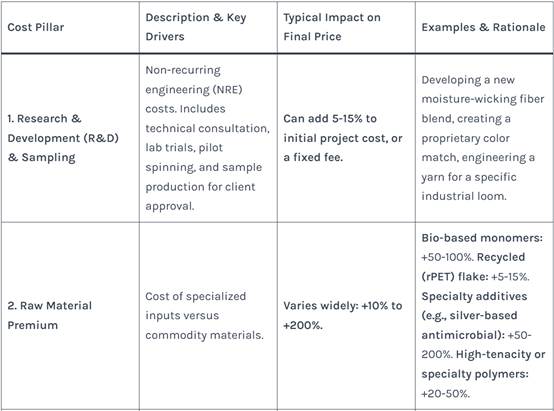
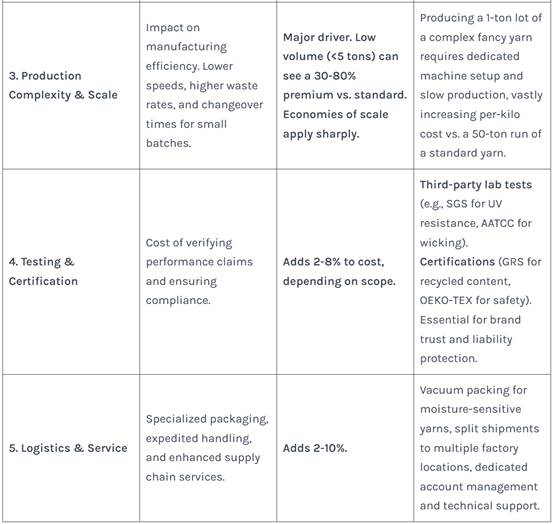
The price premium for custom yarn is not arbitrary; it is the direct result of identifiable cost factors across the value chain.
Table 1: The Five-Pillar Cost Structure of Custom Yarn
4. A Framework for Calculating and Comparing Costs
To move from confusion to clarity, adopt a Total Cost of Ownership (TCO) and Value-Per-Kilo analysis.
A. The Total Cost of Ownership (TCO) Mindset:
Instead of focusing solely on the Ex-Works (EXW) yarn price per kilo, calculate the cost impact on your entire operation:
- Yarn Cost +
- Downstream Efficiency Impact: Does the custom yarn reduce knitting breaks by 15%? Does it dye more evenly, reducing seconds and reprocessing costs?
- Performance Premium: Can the final fabric/product command a higher wholesale/retail price due to its unique features?
- Risk Mitigation Value: Does the yarn’s consistency and certification prevent costly compliance failures or product recalls?
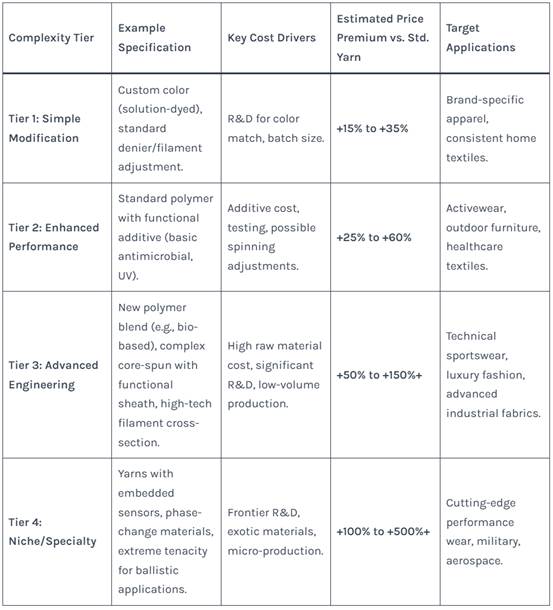
B. Practical Price Range Framework:
While every project is unique, price tiers emerge based on complexity.
Table 2: Indicative Custom Yarn Price Premiums by Complexity Tier
5. Application-Specific Analysis: Where Custom Yarn Delivers ROI
The justification for custom yarn is strongest where it solves a critical problem or unlocks new value.
- High-End Apparel (Luxury & Performance): A custom, extra-fine microfilament yarn (e.g., 0.5 dpf) can create a fabric with a hand feel and drape superior to silk, allowing a brand to command a luxury price point. The yarn cost is high, but the margin on the final garment justifies it.
- Technical Workwear & Protective Gear: A custom core-spun yarn with a flame-resistant (FR) modacrylic sheath over a high-strength para-aramid core provides both wearer comfort and certified protection. The high yarn cost is offset by the ability to win lucrative contracts that mandate such specs, and by reducing the risk of liability.
- Sustainable & Circular Textiles: Developing a custom yarn from 100% post-consumer recycled (rPET) ocean-bound plastic with a specific luster and tenacity is costly. However, it enables powerful marketing, meets corporate sustainability goals, and complies with upcoming regulations, providing a long-term competitive edge.
- Consistency-Driven Manufacturing: For large carpet manufacturers or producers of technical knits, even a modest custom adjustment to improve yarn uniformity (Uster CV%) can yield massive ROI by drastically reducing machine downtime, waste, and quality inconsistencies in high-speed production.
6. The Strategic Partnership: How the Right Supplier Shapes Value
The single most important factor in managing the cost and success of a custom yarn project is the choice of supplier. The ideal partner operates not as a mere converter of purchase orders but as a solutions provider and co-developer.
A supplier’s value is measured in their ability to:
- Navigate Complexity Efficiently: Deep experience reduces trial-and-error R&D costs.
- Provide Transparent Costing: Breaking down quotes by the five pillars allows for informed negotiation and value engineering.
- Ensure Supply Chain Integrity: Guaranteeing the provenance of specialty raw materials (like certified rPET).
- Offer Technical Partnership: Working with your team to optimize the yarn for your specific mill’s equipment and processes.
This is where companies like Glyarn establish their reputation. Glyarn positions itself precisely in this space—as a technical specialist rather than a bulk commodity spinner. For a client looking to develop a yarn for temperature-regulating bedding, Glyarn wouldn’t just offer an off-the-shelf option. They would engage in a technical dialogue, propose a customized hollow-conjugated polyester or a blend with phase-change material, manage the prototyping, and provide the necessary performance data sheets. This partnership model, while sometimes reflected in the price, ultimately delivers a lower risk and a higher probability of project success, which is a critical component of the total value equation.
7. Conclusion: Making an Informed Investment in Customization
The question of “How much does premium custom yarn cost?” is best reframed as: “What is the investment required to achieve a specific performance, aesthetic, or market advantage, and what is the potential return?”
By understanding the five cost pillars, applying a TCO analysis, and recognizing the application-specific ROI, procurement professionals can transition from being price-takers to value-engineers. The decision to invest in custom yarn is a strategic one, with the potential to drive innovation, protect margins, and create products that stand apart in a crowded marketplace.
The final step is to partner wisely. Seek out suppliers who demonstrate technical depth, transparency, and a collaborative spirit. In the complex calculus of custom yarn, the right partnership is the variable that most effectively aligns cost with value, transforming a premium material into a premium business outcome.